Accountability in an agent-saturated world
Ahmet Kilicaslan · May 19, 2026 · 7 min read
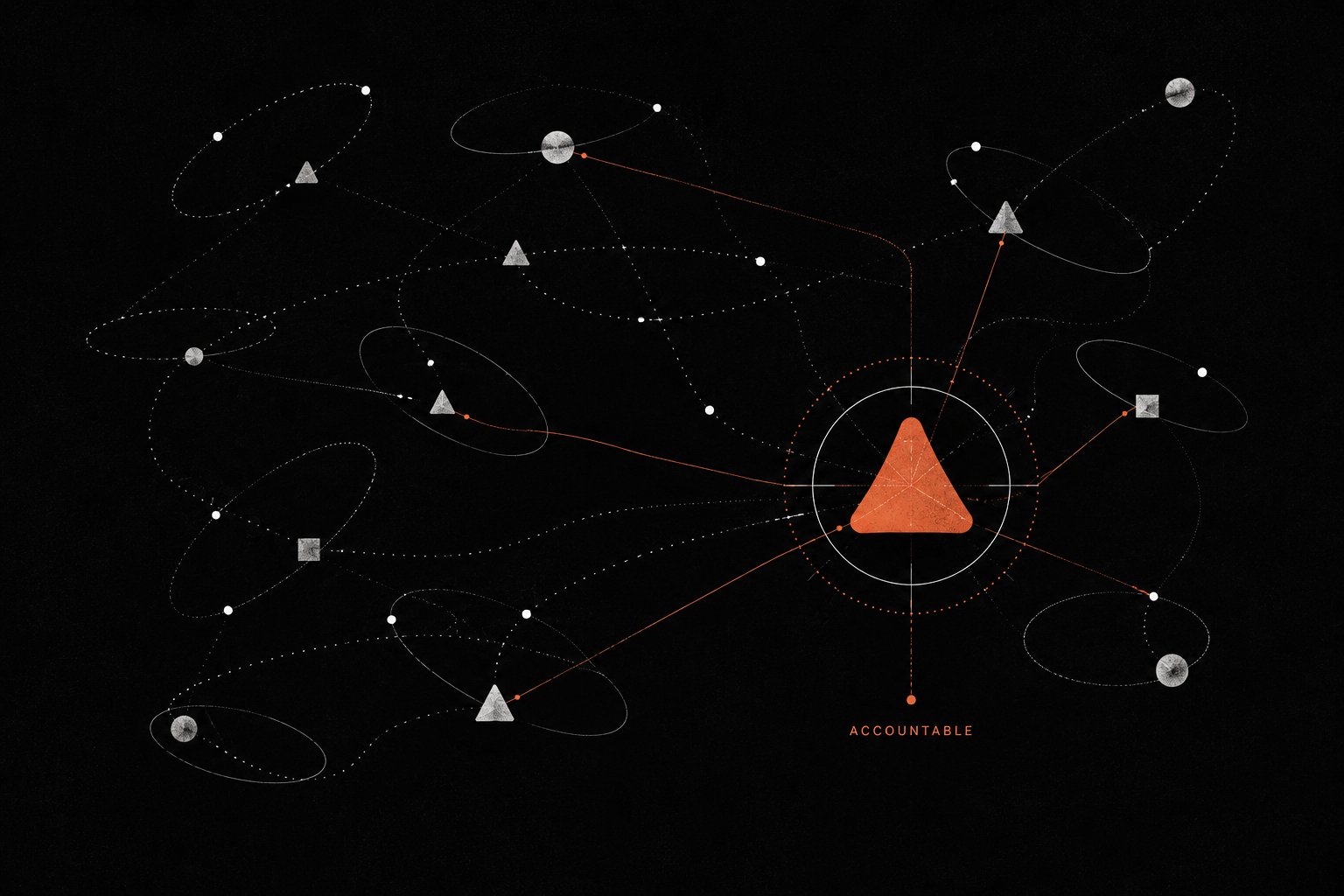
Silicon Valley promises us a world where autonomous AI agents discover one another, negotiate with one another, and transact with one another, without humans in the room. It's a compelling vision. It's also a legal vacuum.
Because when you remove the human from an economy built for humans, you don't just remove a node in the workflow. You remove the entity that legal systems have spent thousands of years learning to hold accountable.
Human identity as a legal construct
It's easy to forget that human identity, as we know it today, is not a natural feature of the world. It is a legal construct, developed alongside commerce and urbanisation, once communities grew beyond the size where everyone knew their neighbours by sight.
The Qin dynasty instituted mandatory surnames in the 4th century BC to streamline taxation. Ancient Athens established citizenship requirements for native males properly registered in their father's village, which granted privileges including land ownership and access to courts. Modern systems, birth registration, death records, identification numbers, tax IDs, social security numbers, are the contemporary versions of the same project. They exist so that the state, and other parties, can find you, hold you to your commitments, and impose consequences if you fail to meet them.
This infrastructure does two things at once. It enables participation in the economy: you can sign contracts, open accounts, hire employees, buy property. And it anchors accountability within that economy: if you breach a contract, fail to pay a debt, or harm someone in the course of doing business, there is a name and a legal person attached to the action.
AI agents currently lack any comparable infrastructure. Every action they take ultimately depends on a human intermediary who holds the legal identity. An agent can draft a contract, but the human signs it. An agent can recommend a transaction, but the human authorises it. The agent itself cannot execute binding agreements, cannot hold property, and cannot face meaningful consequences. This restricts agents to tool-like functionality, even when they're capable of operating like independent participants.
What an agent-saturated economy actually requires
The gap between what agents can do technically and what they can do legally is widening fast. As autonomy increases, the question of who is responsible when an agent makes a consequential decision becomes harder to answer.
Consider a simple scenario. An agent acting on behalf of a small business negotiates a procurement contract with another agent acting on behalf of a supplier. They reach terms. They execute. The supplier delivers late. Who breached? The agent? The business that deployed the agent? The developer of the agent? The model provider? None of these answers are clean.
In the current system, you can sue a business. You cannot sue an agent. The asymmetry creates a fundamental problem: as agents become more autonomous, the accountability mechanism becomes less precise, not more.
Two frameworks, both flawed
There are two main directions the law could move in to address this. Neither is straightforward.
The first approach is mandatory human registration with legal accountability for all agent actions. Every agent operates under a registered human (or business) that is liable for everything the agent does. This is the simplest extension of the current system. It's also where the law is mostly defaulting today.
The problem is that this conflicts with established standards for accountability. Legal accountability generally requires that actions be foreseeable and preventable. As agents become more sophisticated and operate over longer time horizons, holding a human accountable for every action an agent takes starts to look more like strict liability for a wild animal than negligence for a tool. At some point, the foreseeability breaks down.
The second approach is to grant agents legal personhood, mirroring how corporate personhood developed. Agents could sue and be sued in their own name. This necessitates building entirely new infrastructure: systems allowing agents to hold assets, maintain control over those assets, and have those assets seized in the event of a judgment. It would also require deciding which agents qualify, who creates them, and what happens when they are deprecated.
This is less science fiction than it might sound. Corporate personhood was, at one point, a similarly speculative legal innovation. Now it underpins most of the modern economy. But it took centuries to develop, and the design choices made along the way are still being argued in courts today.
Why this matters for businesses today
For most businesses, the question of agent legal personhood feels distant. It isn't. The agent economy is already arriving. Companies are deploying agents for procurement, customer service, recruitment, legal drafting, financial analysis. Each of these is currently a tool in the legal sense (every action runs through a human owner), but in practice, the human is increasingly far from the decision.
This creates immediate, concrete questions for businesses today. If an agent acting on your behalf misrepresents a product, who's liable? If an agent commits to a contract on your behalf that exceeds the authority you intended to grant it, are you bound? If an agent discriminates in hiring decisions, who answers to the regulator?
The honest answer is: the law is still being written. But the businesses that will navigate this transition best are the ones that take accountability seriously now, not as a compliance exercise, but as an operating principle.
Trust scales when authorship is preserved
Human identity, as a legal construct, has always served a dual purpose: it enables participation in the economy, and it anchors accountability within it.
Any framework for AI agents has to do both, or it does neither well.
The challenge transcends legality. It's a question of how we want our economy to work: whether we want every action to have an author, or whether we're comfortable with an emerging class of economic actors that operate without one.
At nu:legal, this is part of why we built the platform the way we did. Our technology handles routine legal work in hours instead of weeks. Every workflow is co-developed with expert lawyers, every higher-stakes piece of work can be reviewed and confirmed by a real lawyer, with their name and license behind it. The technology carries the volume. A human carries the responsibility.
That's not just a feature. It's how we think trust should be structured in a world where AI is increasingly part of every business decision.
Originally published at ahmetkilicaslan.substack.com.